Passive fire protection
The parts of a building that hold a fire back without anyone pressing a button.
- Every seal labelled and photographed
- BM TRADA / FIRAS-certificated contractors
- Written price before any work
Active fire protection does something when there is a fire. Alarms sound, sprinklers spray, vents open.
Passive fire protection just sits there. Walls, floors, fire doors, fire stopping, cavity barriers, protected shafts. It holds the fire in one part of the building for long enough for people to get out and for the fire service to work.
It only works as a set
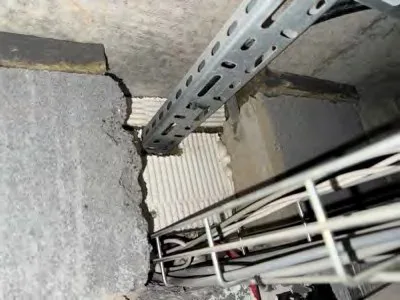
A 60-minute wall with a hole in it is not a 60-minute wall. A fire door in that wall is not much use if the cables above its frame go through an open gap.
So a building with good doors can still fail on compartmentation. And a building with every pipe sealed can still fail on its doors.
The parts we cover
Fire stopping round pipes, cables, ducts and trays. See penetration sealing.
Gaps at the heads and edges of walls, where blockwork or plasterboard meets the slab.
Cavity barriers in roof voids, ceiling voids and wall cavities.
Surveys to find all of the above, and inspections of fire stopping that is already there.
We check the joint between a fire door frame and the wall, because that joint is part of the wall. The doors themselves need a separate fire door inspection.
A fire risk assessment is a separate service too. It looks at the whole building and how people get out. It often leads to the work on this site, but it is not the same job.
What we do not do
We do not design fire strategies, fit dampers in ductwork, or apply intumescent paint to steel. Where a survey turns up something in those areas, it goes on the list for the right trade.
In Manchester
Greater Manchester has a lot of older buildings with newer insides. Mills turned into flats. Warehouses turned into offices. Victorian schools with new IT rooms.
Those buildings tend to have passive protection from two eras that do not quite meet. The old floor and the new riser. The new partition and the old roof. Those joins are where a survey looks hardest.
Send the page that mentions it, the postcode and the number of floors. We come back with what it needs and a written price.